A Future Value Calculator is a financial tool used to determine the value of an investment at a future date, considering interest or returns over time.
<📈 Future Value Calculator
Calculate growth of lump-sum and recurring investments with compound interest
| Year | Investment | Interest | Total Value |
|---|
What is Future Value?
Future value calculator is a fincail calculator that help you to track the value of your current investment in the given time of future. This can be use to track the Initial Investment, Monthly Investment and Interest Rate (%) to determine the Future Value for the investent made today.
Future Value Formula
The future value of an investment is calculated using this formula:
Where:
- FV = Future Value
- PV = Present Value (initial investment)
- r = Interest rate (per period)
- n = Number of periods
Example:
If you invest $10,000 at 8% annually for 10 years, the formula calculates how much your investment will grow over time.
How to Use Future Value Calculator
Using a Future Value Calculator is simple:
- Step 1: Enter Present Value: Input your initial investment or savings amount.
- Step 2: Enter Interest Rate: Provide the expected annual return rate.
- Step 3: Enter Time Period: Enter the number of years you plan to invest.
- Step 4: Click Calculate.
Why Use a Future Value Calculator?
A Future Value Calculator helps you make better financial decisions.
Key Benefits:
✔ Plan your financial goals
✔ Estimate long-term investment growth
✔ Understand the power of compounding
✔ Compare different investment scenarios
✔ Make informed saving decisions
Factors That Affect Future Value
Several factors influence how your investment grows:
- Interest Rate: Higher interest rates lead to higher future value.
- Time Period: The longer you invest, the more your money grows.
- Compounding Frequency: More frequent compounding increases returns.
Future Value vs Present Value
| Metric | Metric |
|---|---|
| Future Value | Value of investment in the future |
| Present Value | Current value of money today |
Both are important for financial planning.
Future Value Examples
Example 1: Savings Growth
Initial Investment: $5,000
Interest Rate: 7%
Time: 10 years
Result: Your investment grows significantly due to compounding.
Example 2: Long-Term Investment
Initial Investment: $20,000
Interest Rate: 10%
Time: 15 years
Shows exponential growth over time.
Common Uses of Future Value Calculator
- retirement planning.
- SIP and mutual fund analysis.
- education planning.
- wealth building strategies.
- inflation-adjusted planning.
what is future value annuity?
The Future Value of Annuity is the total value of a series of regular investments at a future date, including the interest earned. Future Value of Annuity is widely used in:
- Mutual fund SIP calculations
- Recurring deposits (RD)
- Retirement planning
- Insurance savings plans
- Business cash flow planning
Future Value of Annuity Formula
Here’s the formula used to calculate it:
FV=P×r(1+r)n−1
Where:
- FV = Future Value
- P = Regular payment (investment per period)
- r = Interest rate per period
- n = Number of periods
Types of Annuity
Understanding the type of annuity is important because it affects your final returns.
1. Ordinary Annuity
- Payments are made at the end of each period
- Most common type
- Example: SIPs, EMIs
2. Annuity Due
- Payments are made at the beginning of each period
- Earns more interest since money is invested earlier
Where Else Is Future Value Used Besides Annuities?
Future-value calculations are also used in evaluating investment growth, understanding the potential earnings of different investment options, and determining the total cost of mortgages and other similar loans.
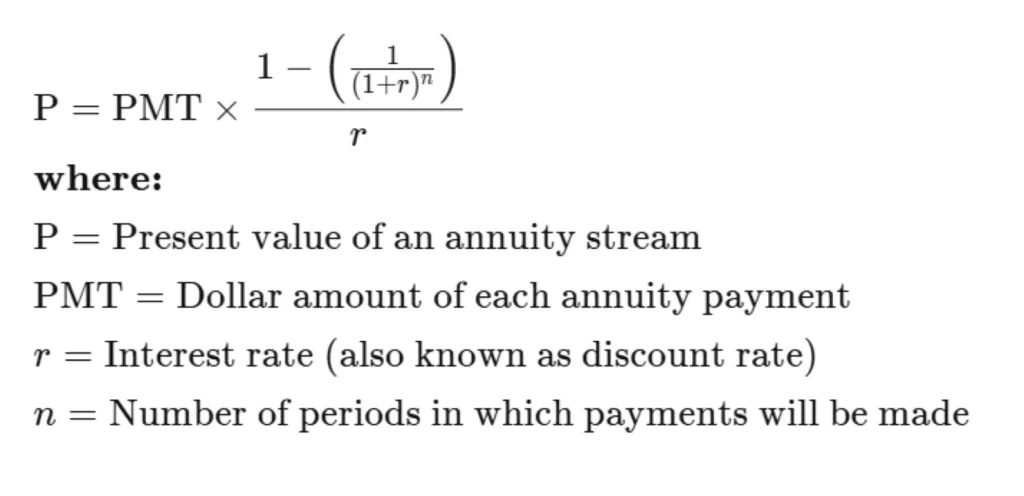
The formula for the present value of an annuity is:
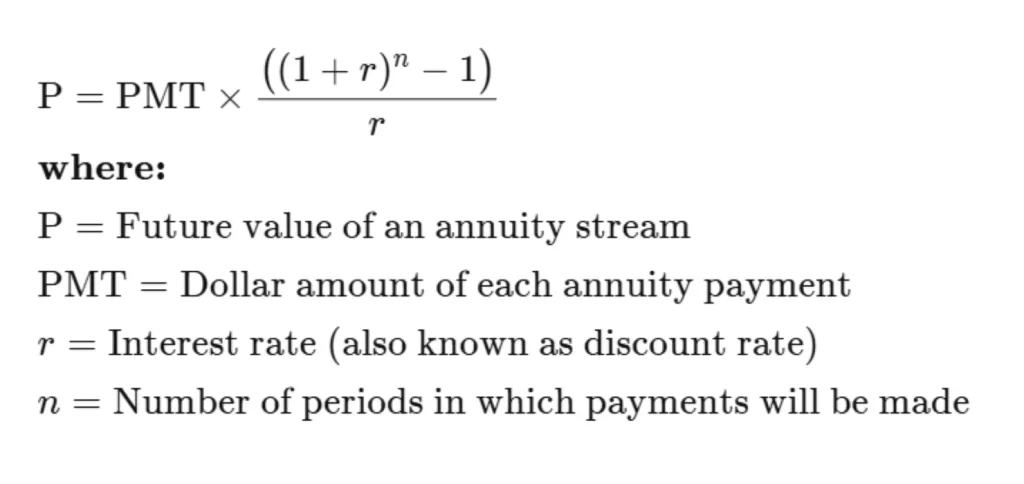
The formula for the future value of an annuity is:
Future Value Calculation-FAQ
What is future value in finance?
Future value is the amount an investment will grow to over time, based on interest or returns.
2. What is the difference between future value and present value?
Present value is the current worth, while future value shows what it will become in the future.
What is a good future value?
A “good” future value depends on your financial goals, investment type, and time horizon.
How does compounding affect future value?
Compounding increases returns because interest is earned on both principal and past interest.
5. Can I calculate future value without a calculator?
Yes, using the formula, but a calculator makes it faster and more accurate.
6. What is future value of SIP?
Future value of SIP calculates how much your monthly investments will grow over time.
7. Does inflation affect future value?
Yes, inflation reduces the real purchasing power of future money.
8. What is the future value of annuity?
It is the value of regular investments (like SIPs) after a certain period.
9. Is future value useful for retirement planning?
Yes, it helps estimate how much money you will have at retirement.
10. What inputs are required for future value calculation?
initial investment
interest rate
time period
Conclusion
A Future Value Calculator is an essential tool for anyone looking to plan investments and achieve financial goals. By understanding how your money grows over time, you can make smarter decisions and build long-term wealth.